

|
|
|
There are a limited number of catalogues available for Kristalunie, and those that survive are far from complete.
Sometimes it is detective work which reveals things that are undocumented in the 'standard references'. The cup and saucer pictured on the right (cup B) was attributed to Rozendaal by the seller, but since the design is not documented, we were uncertain of the attribution when we started our research. The pressed glass of Maastricht is very rarely marked, so the 1948 pressed glass cup (A-Kley-Blekxtoon, p.120, Cup A on the left of the photo) is unusual. The centre of the saucer shows a very large Kristalunie mark as it's main design element. We currently own quite a few examples of both designs, but only on the closest inspection did we discover that one of our (10) saucers of Cup B has the word 'Holland' lightly stamped into the centre of the saucer. Reassured that we wereon the right track, we asked for help, and got it! |
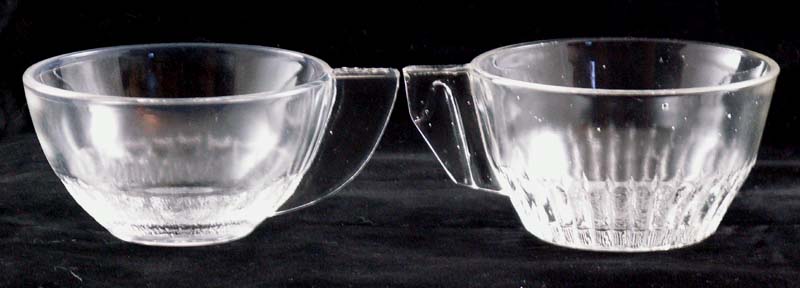 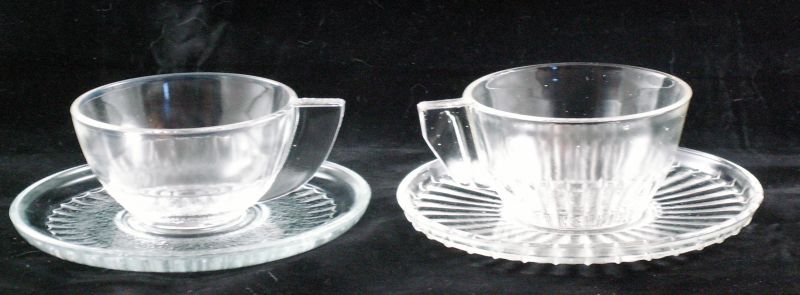 |
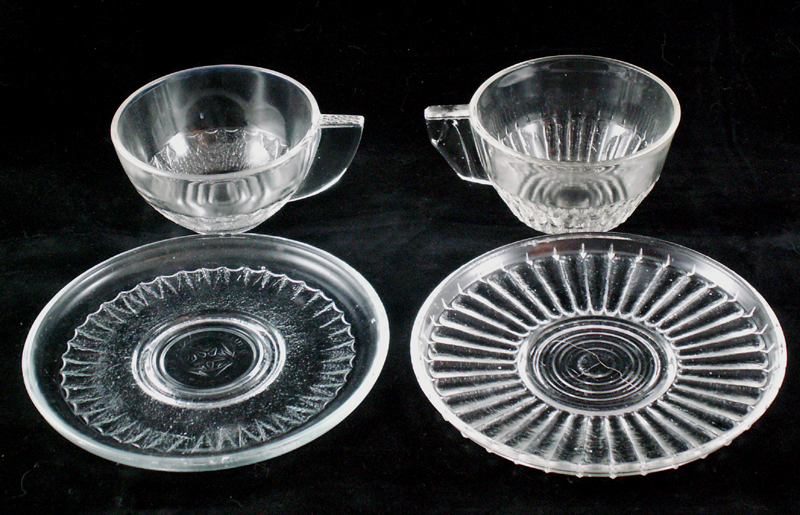 Cup A - Price: 12.50 Cup B - Price: 7.50 |
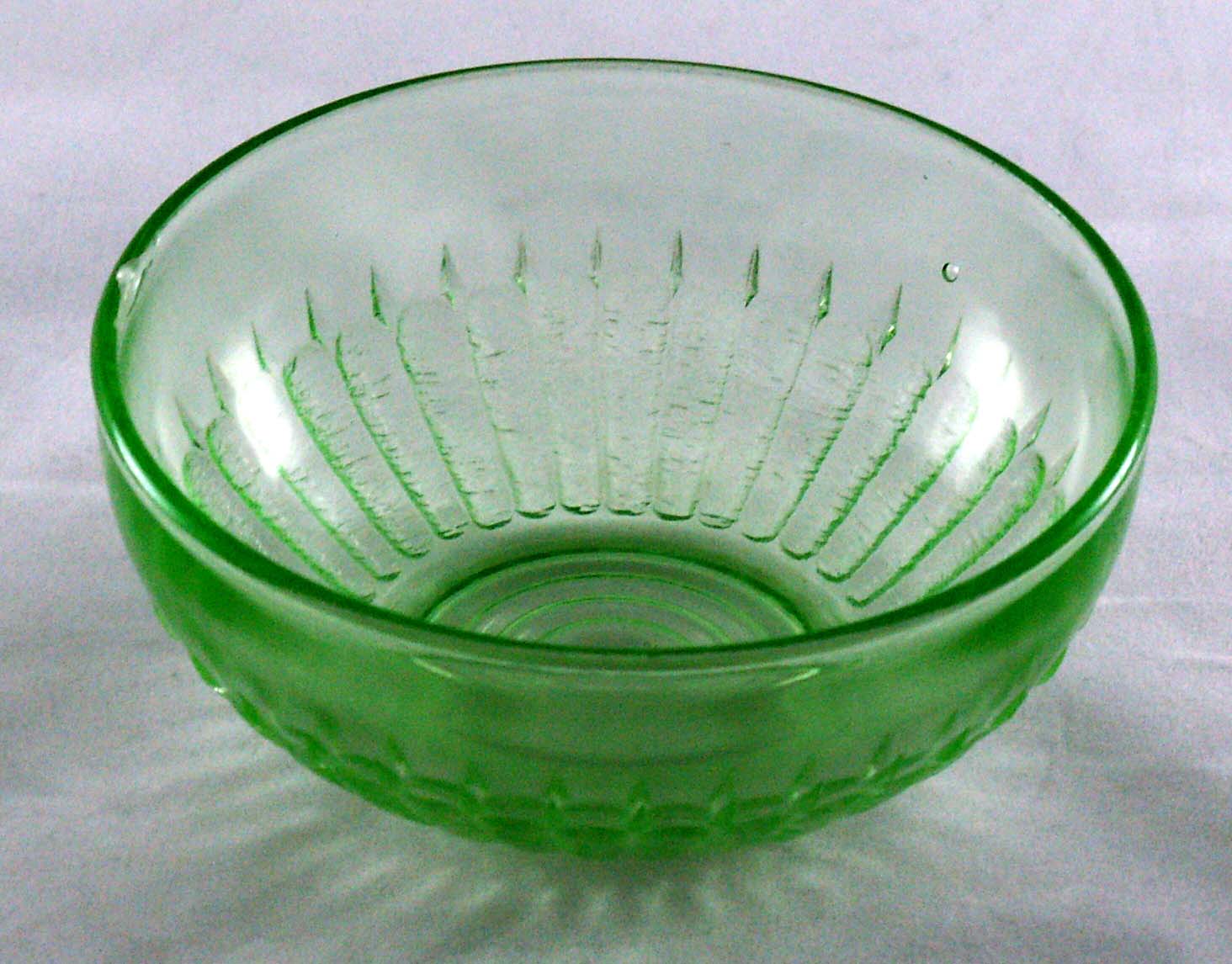
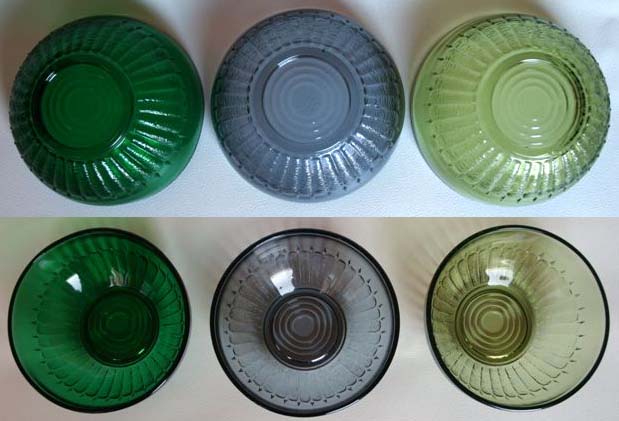
| It's interesting to note that the two items also feel quite different. The glass on the right feels rough. When you pick up the saucer, the pressed underside is uncomfortable in the hand. The cup on the left doesn't have the same problem. The design stops well before the edge to leave a smooth and pleasing rim. The cup on the left also makes use of texturing almost identical to Bambusa, but the scallopped panels are punctuated by small diamonds at the edge of the pattern/under the lip of the saucer. It was this fact which led us to look closely at the light green bowl (shown below left). It shows exactly the same design (with a clear border up to the rim), the same number of panels and same shape of small diamonds as Cup B. |
 |
|
The picture shown above right was recently sent to us for our Carnaval pages, and reveals to us that the same pattern was still being used at Maastricht after Carnaval's launch in 1957. It also confirms that the pattern is from Kristalunie, since these colours were not used at Leerdam. Considering the sequence of events it seems reasonable to conclude that the cup B IS undocumented and: it was made by Kristalunie: it dates from after Bambusa (1935) and was probably superceded by the (improved) cup (on the left) in 1948. There is no cup and saucer to be found in the contemporary sales lists of Bambusa, though it lists almost every other concievable item for the table. The fact that a few saucers are marked 'Holland' suggests that part of the production period was post war. The light-green compote probably dates from around the same date (1943-47) and the design was in use through to at least 1957. The pattern-name has recently been confirmed by Jaqueline Richter (Nat. Glass Museum) as 'China' by Rozendaal, the name possibly referring to the association between bamboo and China. |
 |
|
Copyright (C) Hogelandshoeve & McLellan-Verhoeven, 2019. All rights reserved and images copyright unless otherwise stated. |